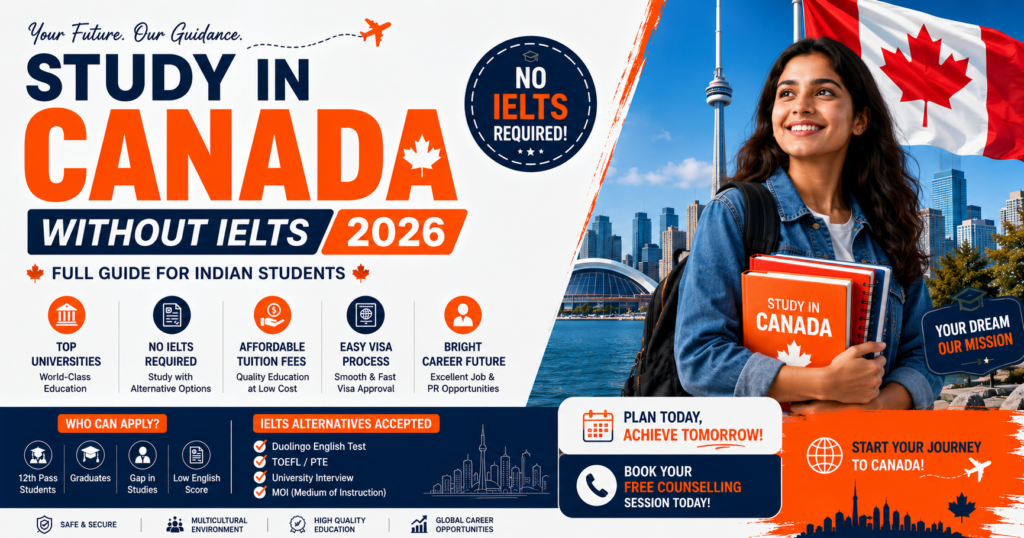
Study in Canada Without IELTS 2026: Full Guide for Indian Students

No IELTS?No Problem!
Indian Students Guide Β· Canada 2026

Study in Canada
Without IELTS β€”
Complete Guide for Indian Students

Canada remains one of the world’s most sought-after destinations for Indian students β€” offering world-class universities, post-graduation work permits, and clear immigration pathways. The good news? You may not need IELTS at all. Discover every alternative, every eligible university, and exactly how to apply in 2026.

10+IELTS-Waiver Universities
4Alternative English Tests
CAD $15K–$45KAnnual Tuition Range
PGWPWork Permit Post-Study
Overview

Can You Study in Canada Without IELTS?

βœ“ Yes β€” It’s Absolutely Possible

Many Canadian universities and colleges accept alternative proof of English proficiency, allowing eligible international students to pursue higher education without submitting IELTS scores. If you have studied in English-medium institutions, completed prior education in English, or can provide results from other recognised language tests, you may already qualify for admission.

Indian students from cities like Chennai, Pondicherry, Bengaluru, Hyderabad, Coimbatore, Kochi, and more are choosing Canada each year β€” and a significant number do so without ever appearing for IELTS. Universities may permit English-medium education certificates, alternative tests, university pathways, or language preparation courses as substitutes.

πŸ’‘ Key Insight: Most institutions evaluate students individually. A strong academic background from a recognised English-medium school or college in India can often satisfy English proficiency requirements on its own.

Section 1

Why Do Indian Students Want to Study Without IELTS?

The IELTS exam β€” while widely recognised β€” is not always the most practical option for every student. Several practical, financial, and academic reasons are driving the growing demand for IELTS-waiver pathways among Indian applicants to Canadian universities.

⏱️
Saves Considerable Time

Preparing thoroughly for IELTS typically takes several months of dedicated study. Students pursuing time-sensitive admissions cycles or mid-year intakes benefit significantly from skipping this process and applying directly.

πŸ’°
Reduces Financial Burden

IELTS registration fees, coaching institute charges, and preparation materials add up substantially. Waiver pathways eliminate these costs entirely, making Canada more financially accessible.

πŸŽ“
English-Medium Academic Background

A large majority of Indian students have completed their schooling and undergraduate education entirely in English. For these students, sitting a language proficiency test can feel redundant β€” and many Canadian institutions agree.

πŸ”„
Flexible Alternative Options

Canadian institutions are increasingly accepting PTE Academic, Duolingo English Test, TOEFL iBT, and university-specific English assessments as equally valid alternatives β€” giving students genuine choice.

Section 2

Alternative English Language Tests Accepted in Canada

Canadian universities and colleges recognise a wide range of English proficiency tests beyond IELTS. If you prefer a digital, faster, or more affordable option, the following alternatives are accepted by most institutions.

PTE Academic

Pearson Test of English Academic

One of the most widely accepted IELTS alternatives across Canadian universities, colleges, and immigration pathways.

  • Fast digital results within 48 hours
  • Flexible test scheduling year-round
  • Fully computer-based, no human bias
  • Widely accepted by IRCC for visa purposes
Duolingo English Test

Duolingo English Test (DET)

Rapidly gaining popularity among international students for its affordability, convenience, and speed.

  • Take the test online from home
  • Results available within 48 hours
  • Significantly lower cost than IELTS
  • Accepted by hundreds of Canadian programs
TOEFL iBT

TOEFL iBT (Internet-Based Test)

A globally recognised benchmark accepted by universities, colleges, and research institutions across Canada.

  • Accepted by virtually all Canadian institutions
  • Strong recognition for graduate programs
  • Available at authorised test centres
  • Also accepted at the border for immigration
MOI Certificate

English Medium of Instruction Certificate

For students whose entire previous education was conducted in English, this certificate may satisfy requirements without any test at all.

  • Certificate of Medium of Instruction (MOI)
  • English-medium school education certificate
  • English-medium undergraduate degree certificate
  • Must be issued by the educational institution
TestFormatResult TurnaroundApprox. Cost (INR)Acceptance Level
IELTS AcademicPaper / Computer3–13 daysβ‚Ή17,000 – β‚Ή18,000Universal
PTE AcademicComputer-Based48 hoursβ‚Ή15,900 – β‚Ή17,500Very High
TOEFL iBTInternet-Based6–10 daysβ‚Ή15,000 – β‚Ή17,000Very High
Duolingo English TestOnline (Home)48 hoursβ‚Ή4,000 – β‚Ή5,500High
Cambridge English (C1/C2)Paper / Computer3–6 weeksβ‚Ή15,000 – β‚Ή20,000Moderate–High
MOI CertificateInstitutional DocumentVaries by UniversityMinimal / NilVaries by University
Section 3

Top Canadian Universities That Accept Students Without IELTS

Several well-regarded Canadian universities and colleges have established IELTS-alternative pathways for international students. Requirements can change from year to year, so always verify directly with admissions offices before applying. The institutions below are widely known for accepting alternative English proficiency documentation.

InstitutionTypeProvinceNotable ProgramsCommon Alternative Accepted
University of WinnipegUniversityManitobaBusiness, Science, Arts, Computer ScienceDuolingo, PTE, MOI Certificate
Brock UniversityUniversityOntarioBusiness Administration, Engineering, EducationDuolingo, TOEFL, PTE
Memorial University of NewfoundlandUniversityNewfoundlandEngineering, Medicine, Business, ScienceDuolingo, TOEFL, MOI
University of ReginaUniversitySaskatchewanEngineering, Business, Social WorkDuolingo, PTE, TOEFL
Concordia UniversityUniversityQuebecFine Arts, Engineering, Business, ScienceDuolingo, TOEFL, PTE
Carleton UniversityUniversityOntarioJournalism, Engineering, Public Policy, ITDuolingo, TOEFL, Cambridge
University of SaskatchewanUniversitySaskatchewanAgriculture, Medicine, Engineering, LawDuolingo, TOEFL, PTE, MOI
Seneca CollegeCollegeOntarioIT, Business, Health, Media & DesignDuolingo, PTE, MOI Certificate
George Brown CollegeCollegeOntarioCulinary Arts, Business, Health SciencesDuolingo, TOEFL, MOI
Centennial CollegeCollegeOntarioAviation, Engineering Technology, BusinessDuolingo, PTE, TOEFL

⚠️ Important: Requirements are updated regularly. Always check the latest admission conditions directly with the university’s international admissions team before submitting your application. Program-level requirements may differ from institution-wide policies.

Section 4

Eligibility Requirements for Indian Students

Not requiring IELTS does not mean there are no eligibility criteria. Canadian institutions still maintain rigorous academic standards. Below are the typical requirements for undergraduate and postgraduate admissions.

πŸŽ’ Undergraduate Admission Requirements

RequirementDetails
Academic Qualification10+2 / Class 12 completion with strong academic performance
Minimum GradesTypically 65–75% aggregate (varies by university and program)
English ProficiencyIELTS alternative test or MOI certificate
Statement of PurposeRequired by most institutions
Letters of RecommendationUsually 1–2 reference letters from teachers or counselors
PassportValid for duration of study program

πŸŽ“ Postgraduate Admission Requirements

RequirementDetails
Academic QualificationRecognised bachelor’s degree from accredited institution
Minimum GradesTypically 60–70% or equivalent GPA
Academic TranscriptsOfficial transcripts from all previous institutions
Statement of Purpose (SOP)Detailed and program-specific SOP required
CV / ResumeAcademic and professional achievements
Work ExperienceRequired for some MBA and management programs
Letters of RecommendationTypically 2–3 academic or professional references
Section 5

Student Visa Requirements for Canada

Admission without IELTS does not automatically simplify the visa process. Canadian immigration authorities require detailed documentation, and students must demonstrate genuine intent and financial capability. Here is what you need to prepare.

πŸ“Œ Note: Visa approval is subject to the discretion of IRCC (Immigration, Refugees and Citizenship Canada) and depends on your application, university admission requirements, and immigration policies at the time of application.

Document / RequirementDetailsStatus
Valid PassportMust be valid for the full duration of the study programMandatory
Letter of AdmissionOfficial acceptance letter from a Designated Learning Institution (DLI)Mandatory
Proof of Financial SupportBank statements showing funds to cover tuition and living expenses (approx. CAD 10,000+ beyond first-year fees)Mandatory
Academic TranscriptsCertified copies of all previous academic records and mark sheetsMandatory
English Proficiency ProofTest scores (PTE, Duolingo, TOEFL) or MOI certificate accepted by your universityMandatory
Statement of PurposeClearly explaining your study goals and intent to return after studiesStrongly Recommended
Visa Application FormCompleted Study Permit application via IRCC online portalMandatory
BiometricsFingerprints and photo at authorised VAC (Visa Application Centre)Mandatory
Medical ExaminationRequired for programs longer than 6 months or involving healthcareConditional
Section 6

Cost of Studying in Canada

Understanding the total financial commitment before applying is essential for planning purposes. Canadian tuition and living costs vary significantly by province, institution type, and lifestyle. The figures below are indicative annual estimates in Canadian Dollars (CAD).

πŸŽ’

Undergraduate Tuition

CAD $15,000 – $35,000 Per academic year Β· Varies by program & province
πŸŽ“

Postgraduate Tuition

CAD $18,000 – $45,000 Per academic year Β· Higher for MBA / Medical programs
🏠

Living Expenses

CAD $12,000 – $20,000 Per year Β· Rent, food, transport, utilities
Expense CategoryEstimated Annual Cost (CAD)Notes
Tuition Fees (UG)$15,000 – $35,000Depends on program and university ranking
Tuition Fees (PG)$18,000 – $45,000MBA, Engineering, and Health programs tend to be higher
Accommodation$6,000 – $14,000On-campus generally more affordable than off-campus in Toronto/Vancouver
Food & Groceries$3,000 – $5,500Cooking at home significantly reduces this cost
Transportation$1,000 – $2,500Student transit passes available in most cities
Health Insurance$600 – $1,200Mandatory; some provinces cover international students
Books & Supplies$800 – $1,500Varies significantly by program
Miscellaneous / Personal$1,500 – $3,000Entertainment, clothing, travel, personal care
CAD $1β‰ˆ β‚Ή62–64 (approx. 2026)
20 hrs/weekWork permitted during studies
40 hrs/weekDuring scheduled breaks
3 YearsMax PGWP after graduation
Section 7

Scholarships for Indian Students in Canada

Financial aid is available to high-achieving and talented international students through university-specific bursaries, government programs, and private foundations. Below are the most commonly available scholarship categories for Indian students applying without IELTS.

πŸ…

Entrance Bursaries & Merit Scholarships

Awarded at the point of admission based on academic excellence. Students with outstanding 12th or undergraduate grades are automatically considered by many Canadian universities. No separate application is required in most cases.

🌍

International Student Scholarships

Specifically designed to attract outstanding students from around the world, including India. These awards typically range from CAD $1,000 to CAD $10,000 per year and may be renewable based on academic performance.

πŸ”¬

Research Fellowships & Graduate Scholarships

Open to master’s and doctoral students, these awards support advanced research in technology, science, health, and engineering. Recipients often receive tuition waivers plus monthly stipends while conducting university-affiliated research.

πŸ›οΈ

Provincial Funding & Government Programs

Certain Canadian provinces, including Manitoba, New Brunswick, and Nova Scotia, offer additional financial incentives to attract international students and skilled graduates who may choose to settle in the province after completing their education.

🀝

Need-Based Financial Aid

Some institutions offer emergency bursaries and need-based grants for international students facing unexpected financial hardship. These are assessed case-by-case and typically do not need to be repaid.

Section 8

Benefits of Studying in Canada

Beyond the absence of an IELTS requirement, Canada offers a genuinely compelling package of academic, professional, and lifestyle advantages for Indian students choosing to study abroad in 2026.

πŸ†
Globally Recognised Degrees

Canadian degrees from accredited institutions are respected by employers and governments worldwide, opening doors across every major economy.

πŸ’Ό
Post-Graduation Work Permit (PGWP)

International graduates from Canadian DLIs are eligible for open work permits up to three years in duration, allowing full-time work in any field.

🍁
Clear Immigration Pathways

Canada’s Express Entry, Provincial Nominee Programs (PNPs), and the Canadian Experience Class provide clear, merit-based routes to permanent residency for international graduates.

🌐
Multicultural Environment

Canada is one of the most culturally diverse nations in the world. Indian students find familiar food, festivals, communities, and a welcoming atmosphere across all major cities.

πŸ₯
High Quality of Life

Safe communities, world-class healthcare, robust public infrastructure, and a high standard of living make Canada consistently rank among the best countries in the world to live in.

πŸ’‘
Innovation & Research Ecosystem

Canada is home to leading AI labs, tech startups, research universities, and major global employers β€” providing students with extraordinary professional development opportunities.

Section 9

Step-by-Step Application Process: Study in Canada Without IELTS

Applying to a Canadian university without IELTS follows the same general process as a standard application β€” with the addition of identifying the right institution and gathering the correct alternative English proficiency documentation.

1

Research & Shortlist Universities

Identify Canadian universities and colleges that explicitly accept alternative English proficiency proofs for international students. Check whether your intended program β€” not just the institution β€” has specific requirements, as these can differ at the department level.

2

Review Detailed Admission Requirements

Visit each university’s international admissions page and confirm the exact English proficiency alternatives they accept. Note minimum scores for each test, and whether MOI certificates are accepted for your specific program type (UG or PG).

3

Prepare Your Complete Document Package

Collect all required documents: academic transcripts and mark sheets, a strong Statement of Purpose (SOP), letters of recommendation, a copy of your passport, your English proficiency proof (MOI certificate or alternative test score), and a current CV if applying for postgraduate programs.

4

Submit Your Application

Apply via the university’s official online portal or through a centralised provincial application system (e.g., OUAC for Ontario universities). Pay the application fee and upload all required documents. Apply to multiple institutions to improve your chances.

5

Review Your Offer Letter Carefully

Upon receiving a conditional or unconditional offer, review all listed conditions carefully. If the offer is conditional on English proficiency documentation you have not yet submitted, gather and provide it promptly to receive your final unconditional letter of admission.

6

Apply for Your Canadian Student Visa (Study Permit)

With your unconditional offer letter in hand, apply for your Canadian Study Permit via the IRCC online portal. Ensure all financial documentation is in order, book biometrics at the nearest VAC, and allow ample processing time before your program start date.

7

Pre-Departure Preparation

Arrange accommodation, book your flights, organise health insurance, and connect with your university’s international student support office for pre-arrival guidance. Many universities host online orientation sessions for incoming international students.

Section 10

Career Opportunities After Graduating in Canada

Canada’s strong economy, shortage of skilled professionals, and internationally recognised educational system make it one of the best places in the world to launch a career after graduation. Indian graduates with Canadian degrees are in high demand across multiple high-growth sectors.

πŸ’»

Information Technology

Software development, cloud engineering, cybersecurity, and systems architecture roles are widely available across Canada’s tech hubs.

πŸ€–

Artificial Intelligence

Canada is a global leader in AI research. Machine learning engineers and AI developers command premium salaries across Toronto, MontrΓ©al, and Vancouver.

πŸ₯

Healthcare

Canada faces persistent healthcare worker shortages. Roles for nurses, medical researchers, health administrators, and allied health professionals are consistently in demand.

πŸ“Š

Data Analytics

Data scientists, business intelligence analysts, and database engineers are among the highest-earning professionals across Canadian corporations.

πŸ’°

Finance & Business

Toronto’s financial district and Canada’s major banks consistently recruit internationally educated business and finance graduates.

βš™οΈ

Engineering

Civil, mechanical, electrical, and environmental engineers are in high demand, particularly for Canada’s ongoing infrastructure investment programs.

πŸ“¦

Supply Chain Management

Logistics, procurement, and operations management graduates find strong employment opportunities across Canada’s retail, manufacturing, and e-commerce sectors.

πŸ”

Cyber Security

With organisations across Canada investing heavily in digital security, cybersecurity specialists are among the most actively recruited technology professionals.

SectorCommon Job RolesAverage Starting Salary (CAD)PGWP Eligible
Information TechnologySoftware Developer, Cloud Engineer, DevOps$65,000 – $90,000Yes
Artificial IntelligenceML Engineer, AI Developer, NLP Specialist$80,000 – $120,000Yes
HealthcareHealthcare Admin, Medical Research, Nursing$55,000 – $85,000Yes
Finance & BusinessFinancial Analyst, Accountant, Business Analyst$55,000 – $80,000Yes
EngineeringCivil, Mechanical, Electrical Engineer$60,000 – $90,000Yes
Data ScienceData Scientist, BI Analyst, Data Engineer$70,000 – $100,000Yes
Section 11

Frequently Asked Questions

These are the questions Indian students most commonly ask about studying in Canada without IELTS. Click any question to expand the answer.

Yes. Many Canadian universities and colleges accept alternative evidence of English proficiency, including PTE Academic, Duolingo English Test, TOEFL iBT, Cambridge English qualifications, or a Certificate of English Medium of Instruction β€” depending on your academic background and the specific institution.
Yes. The Duolingo English Test is accepted by a growing number of Canadian universities and colleges for the purposes of admission. However, for the Study Permit (visa) application submitted to IRCC, currently accepted tests include IELTS, PTE, and TOEFL. Check the most current IRCC guidelines at the time of application as policies are updated periodically.
It depends. If your chosen university accepts an alternative English test or MOI certificate, your university application can proceed without IELTS. For the IRCC Study Permit itself, you will need to demonstrate English proficiency as required. Check IRCC’s current accepted tests to confirm which alternatives qualify at the visa stage.
The most popular and widely accepted IELTS alternatives in Canada are PTE Academic (fastest results, computer-based), TOEFL iBT (widely recognised for graduate programs), and Duolingo English Test (most affordable, online home-based test). For students with entirely English-medium education backgrounds, an MOI certificate from their school or college may be sufficient for university admission.
Absolutely. Canada remains one of the world’s top destinations for international students for multiple compelling reasons: globally recognised degrees, generous post-graduation work permits (up to 3 years), diverse and clear pathways to permanent residency, a high quality of life, excellent safety standards, and a multicultural welcoming society that is highly inclusive of Indian students and professionals.
Institutions such as the University of Winnipeg, University of Regina, Memorial University of Newfoundland, Seneca College, George Brown College, and Centennial College are widely recognised for offering flexible English proficiency alternatives including Duolingo, PTE, TOEFL, and MOI certificates. However, admission standards still apply β€” these institutions are not less academically rigorous, they simply offer more English proficiency flexibility.
Total annual costs for Indian students in Canada typically range from CAD $27,000 to $55,000 when combining tuition and living expenses. Undergraduate tuition is approximately CAD $15,000–$35,000, postgraduate tuition runs from CAD $18,000–$45,000, and annual living costs add approximately CAD $12,000–$20,000 depending on city and lifestyle choices.
Yes. International students with a valid Canadian Study Permit are permitted to work up to 20 hours per week during academic sessions and full-time during scheduled university breaks (such as summer and winter holidays). This work experience can also contribute toward post-graduation permanent residency applications through programs like the Canadian Experience Class.

Ready to Study in Canada Without IELTS?

Don’t let the IELTS exam stand between you and your Canadian education dream. Our expert study abroad consultants are here to help you shortlist the right universities, prepare your documents, and navigate every step β€” from admission to visa to arrival.

Serving students from Pondicherry, Chennai, Coimbatore, Bengaluru, Hyderabad, Kochi, Madurai, Trichy, Salem, Erode and across South India.


Leave a Comment

Your email address will not be published. Required fields are marked *

chatgpt image feb 16 2026 12 33 40 pm removebg preview

Do you want us to help you?

No processing fee | Application fee waiver €4000 Scholarship on admit | SOP & LOR preparation Education Loan | Visa Assistance